


Electric anode rapping hammer
The Yangzhen hammer is composed of multiple precision-integrated parts, including a flexible clamping arm, a hammer head, a hammer handle and a vibrating shaft. Its unique feature is that the flexible clamping arm is ingeniously designed as one arm, an arc-shaped flexible arm and another arm. Among them, one arm is tightly connected to the hammer head through a thick large rivet, while the other arm is movably connected to the hammer handle through a delicate small rivet, and finally the hammer handle is firmly fixed on the vibrating shaft.
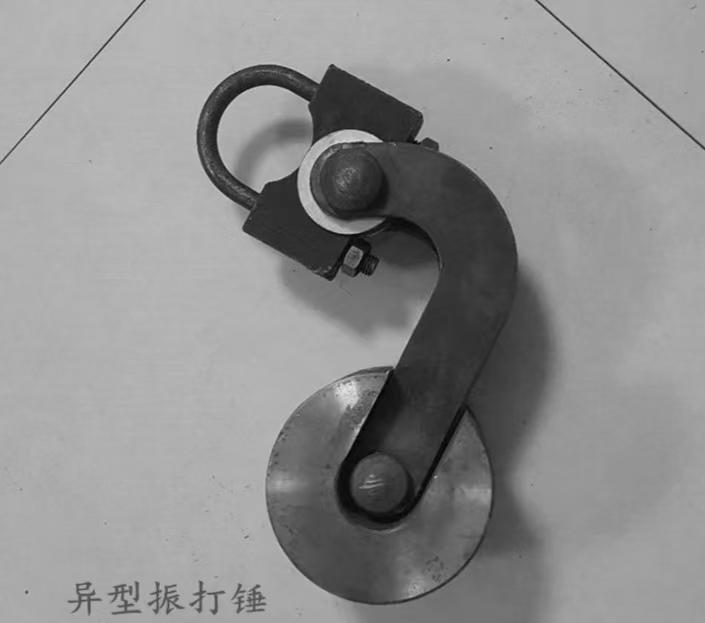
The biggest highlight of the Yangzhen hammer launched by Xiangye Environmental Protection lies in the bending design of the hammer arm. This design enables the curved hammer arm to rotate closely with the shaft when the vibrating shaft rotates, always maintaining a very small distance between the hammer head and the vibrating shaft. Such a design can not only prevent the hammer head from entering the discharge distance of the electric field, thus avoiding the discharge phenomenon between the negative line and the hammer head, but also greatly reduce the lifting force of the hammer head, so that an excellent vibrating effect can be achieved with a vibrating motor of lower power.
Regarding the working principle of the Yangzhen hammer, it removes dust deposited on the plates and wires by making them vibrate. Its shaft buckle has a unique structure, which is composed of two parts: a U-shaped clip and a shaft clip connected to the shaft, and is precision-welded to ensure the correctness of their relative positions. Usually, one vibrating hammer is installed for a row of plates, while multiple rows of vibrating hammers in the same electric field are placed on one transmission shaft, with each row staggered at a certain angle, so that each row of plates can be vibrated alternately. The intensity and frequency of vibration can be flexibly adjusted through an intelligent electric control device.
| Machinery & Equipment/Plastic Machinery/Plastic Machinery Auxiliaries | |


